
 By the AI Workout team
In this article+
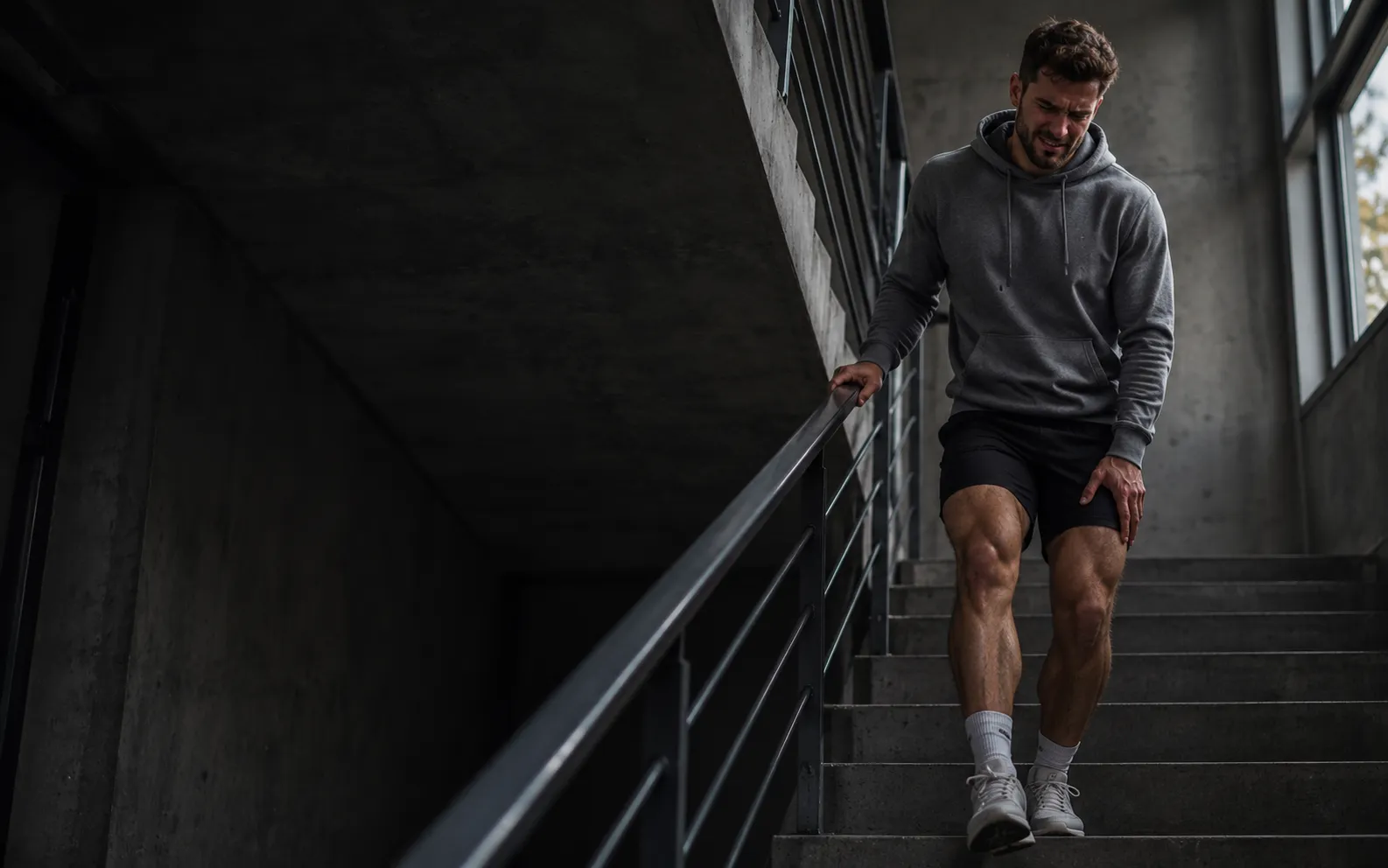
You did your first leg workout on Monday. On Tuesday you feel fine. On Wednesday you can’t sit down without holding on to something. That’s delayed onset muscle soreness, or DOMS. It’s normal, it doesn’t mean you’re injured, and it gets much better after the first couple of weeks.
Why your muscles get sore
DOMS happens when you ask your muscles to do something they’re not used to, especially the lowering part of a lift, like sitting down into a squat. That causes tiny amounts of damage in the muscle, and the soreness comes with the repair.
It isn’t lactic acid. That’s gone from your muscles shortly after you finish training, long before the soreness starts.
How long soreness lasts
| When | What you feel |
|---|---|
| Right after the workout | Tired, but usually not sore |
| 12–24 hours later | Stiff and starting to ache |
| 1–3 days later | Soreness at its worst |
| 5–7 days later | Gone |
It gets better quickly
After that first tough workout, your muscles adapt. The next time you do the same exercises, you’ll be far less sore. Researchers call this the repeated bout effect. It’s why the first one or two weeks are the worst, and why starting with light weights saves you a lot of pain.
Should you train today? A quick check
What actually helps
- Moving gently. A walk, an easy bike ride or a few light warm-up sets.
- Massage. A 2018 review of 99 studies found massage was the best recovery method for reducing soreness and tiredness. A foam roller is a cheap way to try something similar at home.
- Sleep and protein. They won’t fix it overnight, but your muscles repair while you sleep, and they need enough protein to do it.
What doesn’t help much: stretching and ice. Reviews have found little effect from either on soreness.
How to be less sore next time
- Start lighter than you think in your first weeks.
- Add new exercises and extra sets slowly, not all at once. That’s what progressive overload is about.
- Train regularly. Soreness hits hardest after a long break, so a steady routine keeps it small.
Let your plan adjust
With AI Workout Pro, every weekly check-in asks how sore you’ve been. If the soreness isn’t going away, your AI coach suggests changes to next week’s plan, like fewer sets or lighter weights. You decide which changes to accept.
Frequently asked questions
Can I train a muscle that’s still sore?+
If it’s only a little sore, yes. Warm up well and it usually eases off. If it’s very sore, give it another day or two and train something else.
If I’m not sore, did my workout work?+
Yes. Soreness mostly shows that you did something new, not how well you trained. Your muscles can grow and get stronger without hurting the next day.
How do I tell soreness from an injury?+
Soreness is a dull ache spread across the muscle, often on both sides of the body, and it eases as you move. An injury is usually sharp, sits in one spot or a joint, gets worse with movement and may come with swelling or bruising.
Does stretching prevent soreness?+
Not really. Reviews have found that stretching before or after training does little for soreness. Stretch if it feels good, but don’t expect it to stop DOMS.
Sources
- Cheung, Hume & Maxwell (2003). Delayed onset muscle soreness: treatment strategies and performance factors. Sports Med 33(2):145–164.
- McHugh (2003). Recent advances in the understanding of the repeated bout effect: the protective effect against muscle damage from a single bout of eccentric exercise. Scand J Med Sci Sports 13(2):88–97.
- Dupuy et al. (2018). An evidence-based approach for choosing post-exercise recovery techniques to reduce markers of muscle damage, soreness, fatigue, and inflammation: a systematic review with meta-analysis. Front Physiol 9:403.