
 By the AI Workout team
In this article+
Everyone at the gym talks about protein, and the advice ranges from “eat chicken every two hours” to “you don’t need any extra”. The truth is somewhere in between, and it’s simpler than most people make it.
How much protein per day
The best answer we have comes from a 2018 review of 49 studies with almost 1,900 people who lifted weights. Eating more protein helped them build muscle, up to about 1.6 g per kilogram of body weight per day. Above that, the extra benefit mostly stopped. The authors suggest 2.2 g/kg as the upper end if you want to be sure.
The International Society of Sports Nutrition gives a similar range for people who train: 1.4–2.0 g/kg. For comparison, the usual 0.8 g/kg you see on nutrition labels is the minimum for adults who don’t train.
Protein chart by body weight
| Body weight | Daily target (1.6 g/kg) | Upper end (2.2 g/kg) |
|---|---|---|
| 50 kg (110 lb) | 80 g | 110 g |
| 60 kg (132 lb) | 95 g | 130 g |
| 70 kg (154 lb) | 110 g | 155 g |
| 80 kg (176 lb) | 130 g | 175 g |
| 90 kg (198 lb) | 145 g | 200 g |
| 100 kg (220 lb) | 160 g | 220 g |
You don’t need to hit it to the gram. Getting close most days matters far more than being perfect once a week.
How much protein is in everyday food
| Food | Portion | Protein |
|---|---|---|
| Chicken breast, cooked | 100 g | about 31 g |
| Lean beef mince, cooked | 100 g | about 26 g |
| Tuna, canned and drained | 1 can (110 g) | about 25 g |
| Cottage cheese | 200 g | about 22 g |
| Greek yogurt, plain | 200 g | about 20 g |
| Eggs | 3 large | about 19 g |
| Firm tofu | 150 g | about 18 g |
| Lentils, cooked | 200 g | about 18 g |
| Milk | 1 glass (250 ml) | about 8 g |
| Whey protein | 1 scoop (30 g) | about 24 g |
These are rough numbers and brands differ, so check the label when you can.
Not all protein counts the same
The grams on the label don’t tell the whole story. Your body can’t use every gram of protein equally well. How much it gets out of a food depends on how well that protein is digested and on whether it contains all the amino acids your muscles need.
Scientists rate this with a score called DIAAS. In a 2017 study comparing common protein sources, milk proteins like whey scored highest. Soy was close behind. Pea protein and wheat scored lower when eaten on their own.
| Protein source | Protein quality (roughly) |
|---|---|
| Milk, yogurt, whey | Excellent |
| Eggs, meat, fish | Excellent |
| Soy and tofu | Good |
| Peas, beans, lentils | Lower on their own |
| Wheat, bread, pasta | Lower on their own |
That doesn’t mean plant protein can’t build muscle. In a 2021 study, vegans and meat eaters who both ate 1.6 g/kg of protein built the same amount of muscle over 12 weeks.
What 110 g of protein looks like in a day
Here’s an ordinary day for someone who weighs 70 kg. No shakes, no special foods.
| Meal | What you eat | Protein |
|---|---|---|
| Breakfast | 200 g Greek yogurt with oats and berries | about 25 g |
| Lunch | 120 g chicken breast with rice and vegetables | about 40 g |
| Snack | A glass of milk and a handful of almonds | about 13 g |
| Dinner | 3-egg omelette with cheese and two slices of bread | about 33 g |
| Total | about 111 g |
Vegetarian? Swap the chicken for tofu or lentils, and use cottage cheese or skyr as your snack.
Do you need protein powder?
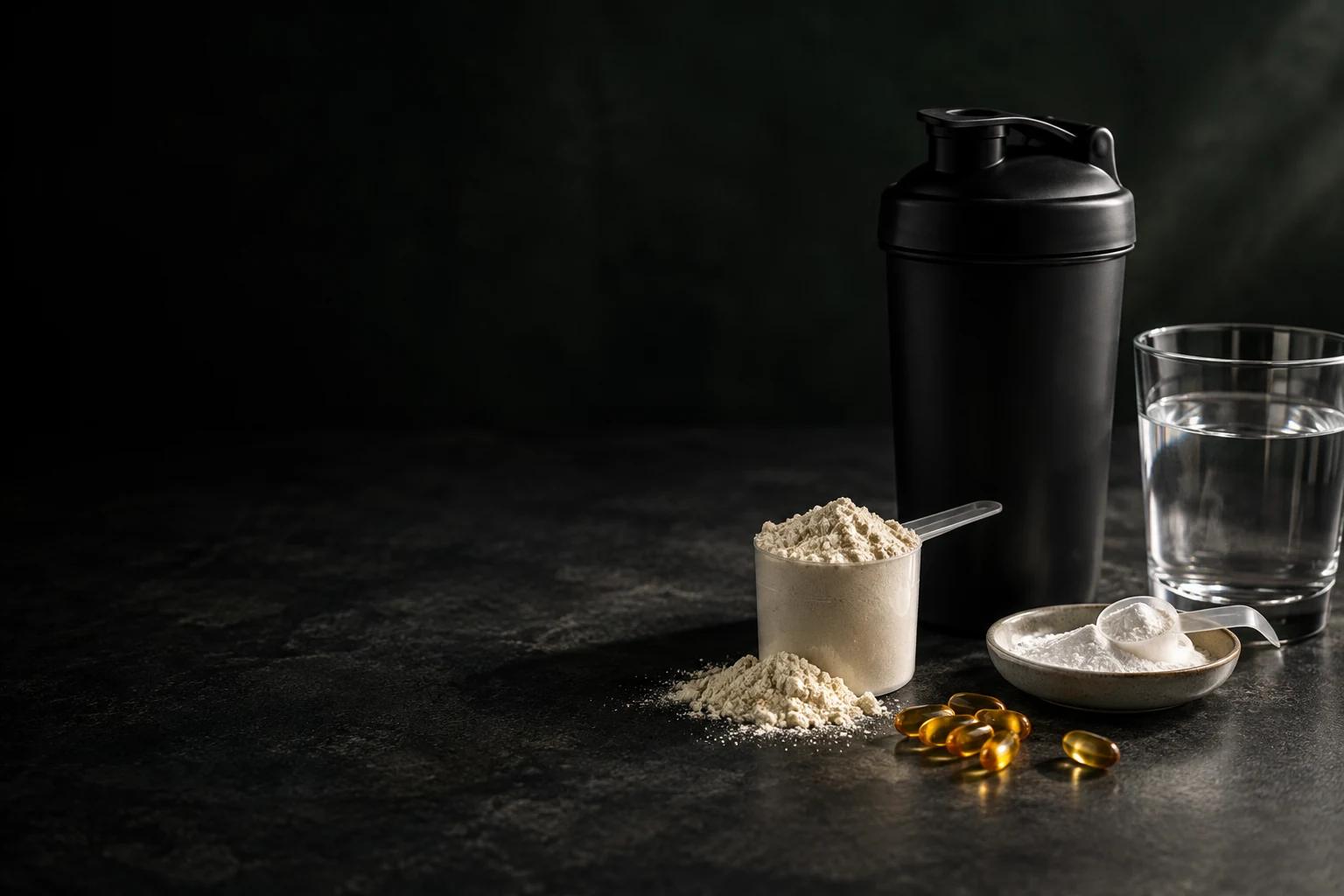
No. Protein powder is just food in a more convenient form. It isn’t better than chicken or yogurt, but it helps if you’re busy, don’t eat much meat or often end the day 20–30 g short. One scoop covers that.
Four habits that make it easy
- Start each meal with the protein. Choose it first, then add the rest of the plate. 20–40 g per meal, over 3–4 meals, gets most people there.
- Rest days count too. Your muscles grow on your days off, so keep your daily total the same.
- Keep easy options at home. Greek yogurt, eggs, canned tuna and cottage cheese need no cooking.
- Don’t worry about timing. Eating within a few hours before or after training is enough. You don’t have to drink a shake right after your last set.
Let your plan do the maths
Your AI Workout plan includes a nutrition plan with a daily calorie target, split into protein, carbs and fat for your goal. It then gives you example days of meals that fit your way of eating, whether that’s vegetarian, vegan or anything else.
Frequently asked questions
Is too much protein bad for you?+
For healthy people who train, intakes around 2 g/kg and above haven’t been shown to cause harm. If you have kidney disease or another health condition, talk to your doctor before you raise your protein.
Do women need less protein than men?+
Per kilogram of body weight, no. The same 1.6 g/kg applies. Women usually weigh less, so the total in grams is often lower.
Is there a limit to how much protein your body can use in one meal?+
The idea that your body can only take 30 g at a time is a myth: you digest and absorb all of it. For building muscle, 20–40 g per meal is a good target, but a bigger meal isn’t wasted.
Should I eat more protein when I’m trying to lose fat?+
Yes, aim for the higher end, closer to 2 g/kg. When you eat less overall, extra protein helps you keep the muscle you have, and it keeps you full for longer.
Sources
- Morton et al. (2018). A systematic review, meta-analysis and meta-regression of the effect of protein supplementation on resistance training-induced gains in muscle mass and strength in healthy adults. Br J Sports Med 52(6):376–384.
- Jäger et al. (2017). International Society of Sports Nutrition position stand: protein and exercise. J Int Soc Sports Nutr 14:20.
- Mathai, Liu & Stein (2017). Values for digestible indispensable amino acid scores (DIAAS) for some dairy and plant proteins may better describe protein quality than values calculated using the concept for protein digestibility-corrected amino acid scores (PDCAAS). Br J Nutr 117(4):490–499.
- Hevia-Larraín et al. (2021). High-protein plant-based diet versus a protein-matched omnivorous diet to support resistance training adaptations: a comparison between habitual vegans and omnivores. Sports Med 51(6):1317–1330.