 By the AI Workout team
In this article+
You want a rounder, stronger butt. What you don’t want is bigger thighs, or a body that looks like a bodybuilder’s. Plenty of women stay away from the weights because of exactly this worry.
Here’s the good news: a muscle only grows when you train it. So you decide what grows by choosing your exercises.
What the research shows
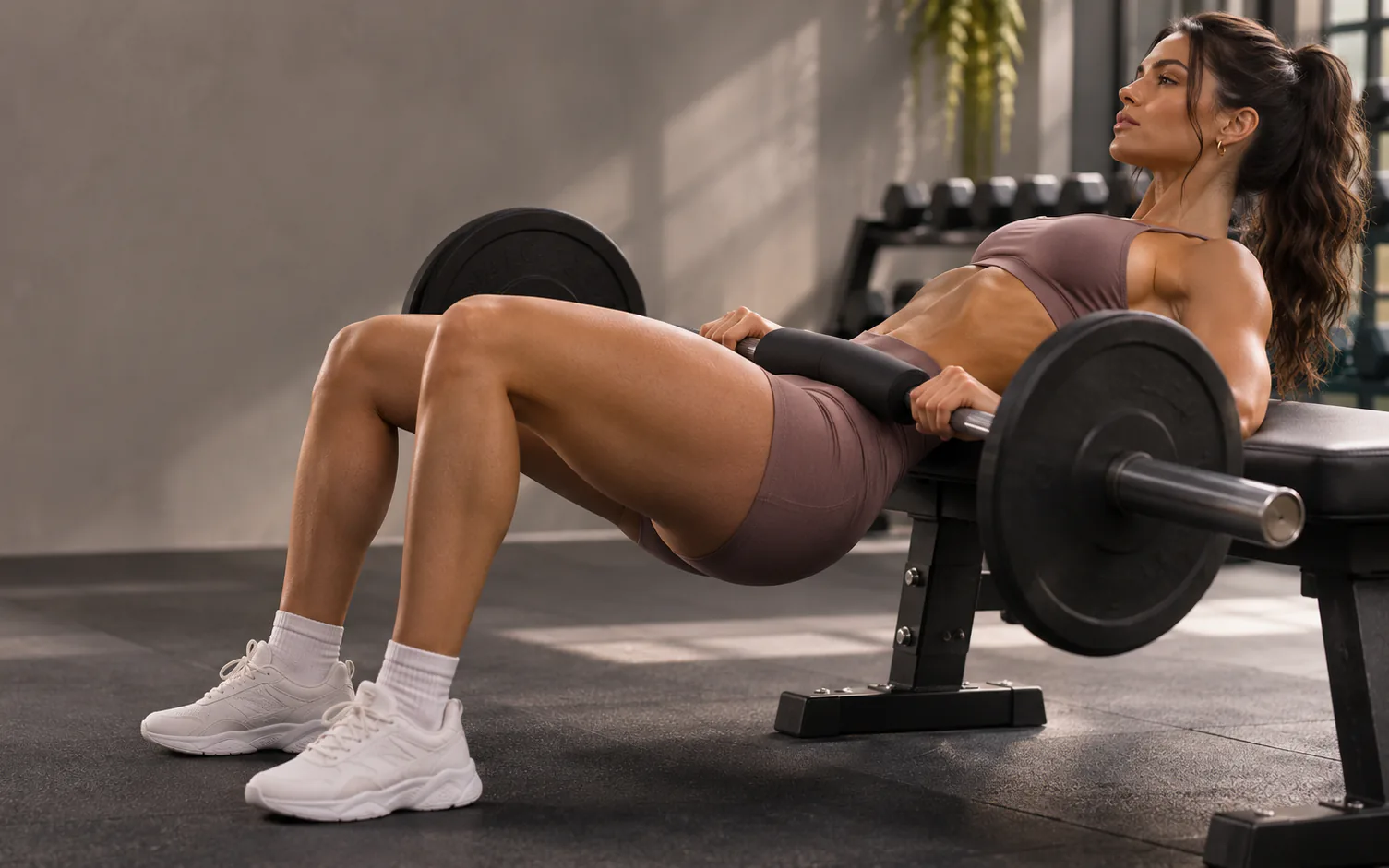
In a 2023 study, 34 beginners, most of them women, trained twice a week for 9 weeks. Half did only barbell squats. The other half did only hip thrusts. MRI scans before and after showed this:
| Muscle | Squat group | Hip thrust group |
|---|---|---|
| Glutes | Grew | Grew about the same |
| Front of thighs (quads) | Grew | Barely changed |
| Inner thighs (adductors) | Grew | Barely changed |
When women say “bigger thighs”, they usually mean the front and the inside of the leg. Those are exactly the muscles squats built and hip thrusts barely touched. Both groups got the same glute growth.
Will you get bulky?
Not by accident. Relative to their size, women build muscle about as well as men do, which is why lifting works for you. But women have around 15 times less testosterone than men and start with less muscle. A big, blocky look takes years of training aimed at it.
When legs feel bulky, it’s usually muscle with a layer of fat on top. No exercise burns fat from one spot. Losing fat comes down to eating a little less than you burn, and the calorie calculator shows you where to start.
Glute-first exercises
The exercises that build your glutes without loading your thighs much have one thing in common: your hips do most of the work, and your knees bend only a little.
| Exercise | Works mostly | Where it fits |
|---|---|---|
| Hip thrust or glute bridge | Glutes | Main lift |
| Romanian deadlift | Glutes, back of thighs | Main lift |
| 45° back extension | Glutes, back of thighs | Extra |
| Cable kickback | Glutes | Extra |
| Hip abduction machine | Upper and side glutes | Extra |
| Step-up, lunge, split squat | Glutes and front of thighs | Use the tweaks below |
| Squat, leg press | Front and inner thighs, glutes | Small part of your week |
| Leg extension | Front of thighs only | Skip it |
Small tweaks that shift the work to your glutes
Step-ups, lunges and split squats are some of the best glute exercises there are, but they also work your thighs. A few small changes move more of the work to your glutes:
- Lean forward slightly. In a lab study, a lunge with the upper body leaning forward made the glutes work harder, while the front thigh worked about the same.
- Take a longer step. In lunges, a longer stride bends your hip more and your knee less. In step-ups, a higher box does the same.
- Put your feet high on the leg press. If you do leg presses, placing your feet near the top of the platform means less knee bend and more hip bend.
A simple glute-focused week
Train three days a week and start every session with your glutes. Alternate two workouts: A, B, A one week, then B, A, B the next.
- MonDay A
- TueRest
- WedDay B
- ThuRest
- FriDay A
- SatRest
- SunRest
| Order | Day A | Day B |
|---|---|---|
| 1 | Hip thrust, 3 × 8–12 | Step-up (high box), 3 × 10 per leg |
| 2 | Romanian deadlift, 3 × 8–12 | Cable kickback, 2 × 12–15 per leg |
| 3 | Lat pulldown, 3 × 10 | Hip abduction, 2 × 15 |
| 4 | Chest press or push-ups, 3 × 10 | Seated row, 3 × 10 |
| 5 | — | Shoulder press, 3 × 10 |
In your first two weeks, do 2 sets of everything. Pick a weight you could lift 2–3 more times at the end of each set (here’s how to choose it), then add a little weight or a rep each week. That steady increase, called progressive overload, is what makes muscle grow.
If you like squats, swap the step-up for a goblet squat once a week.
Be patient, and measure it
Muscle grows slowly. In the study, the change was clear on MRI after 9 weeks, but in the mirror it usually takes a few months. The scale won’t tell you much either, because you can gain muscle and lose fat at the same time. Track these instead:
- Photos from the side and back every 4 weeks, in the same light.
- Hip measurement around the widest part of your hips and glutes, every 4 weeks.
- Your hip thrust weight. If it keeps going up, your glutes are growing.
Muscle also needs building material, so make sure you eat enough protein.
Make glutes the focus of your plan
When you start AI Workout, you can pick Glutes as your focus area. Your plan then puts glute work first, with exercises, sets and starting weights that fit your schedule and equipment. You can log your hip measurement in the app, too, and watch it change month by month.
Build a glute-focused planPick Glutes as your focus area. We build the exercises, sets and starting weights around your week.Frequently asked questions
Will lifting weights make me look bulky?+
Not by accident. Relative to their size, women build muscle about as well as men, which is why training works. But women have around 15 times less testosterone and start with less muscle, so a big, muscular look takes years of training aimed at it. When legs feel bulky, it’s usually muscle with fat on top, and losing fat comes down to calories, not exercise choice.
Do squats make your thighs bigger?+
They can. Squats build your glutes, but also the quads at the front of your thigh and the adductors on the inside. In a 9-week study, squats grew those thigh muscles more than hip thrusts did, while glute growth was about the same.
Can I grow my glutes without squats?+
Yes. In a 2023 study, hip thrusts grew the glutes as much as squats did. Romanian deadlifts, step-ups, back extensions, cable kickbacks and hip abductions are all good glute exercises that don’t need a squat.
How long does it take to grow your glutes?+
In the study, beginners training twice a week had measurable glute growth on MRI after 9 weeks. In the mirror, most people need a few months of steady training. Take photos and measure your hips every 4 weeks so you can see the change.
Sources
- Plotkin et al. (2023). Hip thrust and back squat training elicit similar gluteus muscle hypertrophy and transfer similarly to the deadlift. Front Physiol 14:1279170.
- Roberts, Nuckols & Krieger (2020). Sex differences in resistance training: a systematic review and meta-analysis. J Strength Cond Res 34(5):1448–1460.
- Handelsman, Hirschberg & Bermon (2018). Circulating testosterone as the hormonal basis of sex differences in athletic performance. Endocr Rev 39(5):803–829.
- Krause Neto et al. (2020). Gluteus maximus activation during common strength and hypertrophy exercises: a systematic review. J Sports Sci Med 19(1):195–203.
- Farrokhi et al. (2008). Trunk position influences the kinematics, kinetics, and muscle activity of the lead lower extremity during the forward lunge exercise. J Orthop Sports Phys Ther 38(7):403–409.